

THE MARGIN SQUEEZE OF 2026
Why Commercial Contractors Need a Smarter Estimating Strategy in an Uncertain World
From the 2026 Iran conflict and volatile material prices to labor shortages, tariffs and AI, commercial construction is being reshaped in real time. For flooring, drywall, paint, roofing, stone and countertop subcontractors, accurate takeoffs and scalable estimating capacity are becoming essential tools for protecting margins.
Illustrative office-based estimating environment. Pinnacle estimators perform digital takeoff and estimating work from office settings, not from the field.
8.4%
May 2026 year-over-year increase in inputs to new nonresidential construction
349K
New construction workers estimated to be needed in 2026
28%
Year-over-year growth in data center construction in April 2026
2026 Has Changed the Commercial Construction Equation
Commercial contractors entered 2026 expecting another challenging year. What followed made forecasting, budgeting and bidding even more difficult.
The market still contains significant opportunity. The 2026 mid-year construction assessment provided to Pinnacle reported relatively strong backlog conditions and a substantial improvement in its project stress index. Data center construction was a major bright spot, up 28% year over year in April and accounting for roughly $50 billion in monthly spending.
But beneath those positive indicators is a much more difficult margin story. The same report found that inputs to new nonresidential construction rose 8.4% year over year in May, while construction energy prices surged. More recent AGC data showed nonresidential construction input costs still 7.1% above the prior year in June, while contractor bid prices had risen only 3.5%.
That gap matters. When input costs move materially faster than bid prices, specialty contractors have less room for missed quantities, overlooked scope, slow revisions or inconsistent estimating capacity.
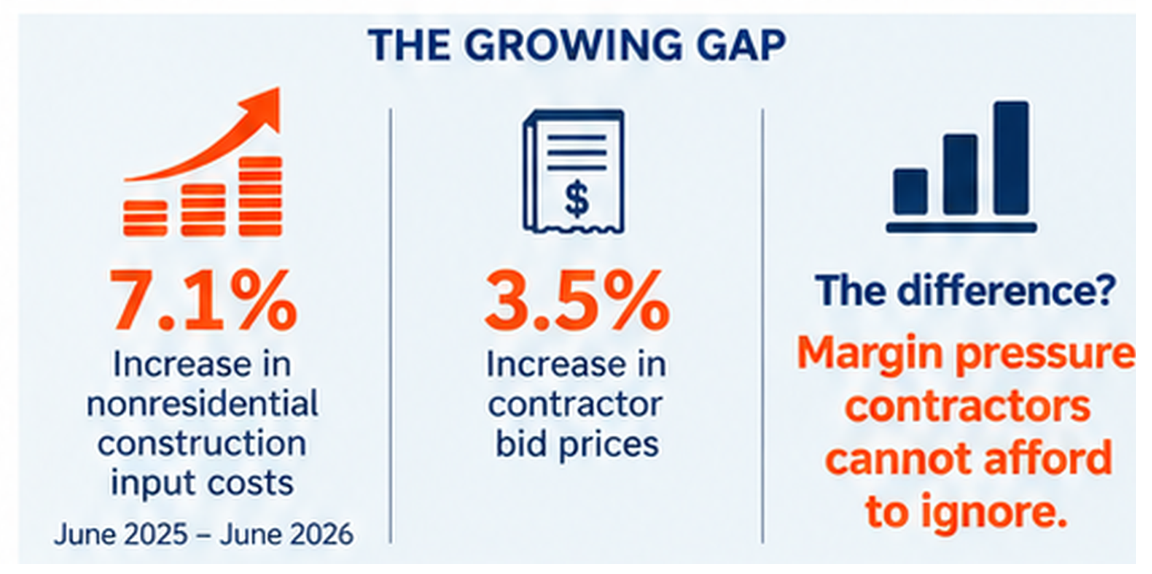
Construction input costs have been rising faster than contractor bid prices, increasing pressure on already-tight margins.
The Iran Conflict May Be Thousands of Miles Away. Its Cost Impact Is Not.
The 2026 Iran conflict demonstrated how quickly geopolitical events can move through the construction supply chain. The mid-year assessment links disruption around the Strait of Hormuz to a sudden petroleum shock and cascading pressure on fuel, shipping and petroleum-dependent construction products.
The report specifically identifies asphalt, PVC, HDPE, sealants and material transportation as vulnerable areas. By May, crude petroleum prices had risen sharply, adding another layer of uncertainty to procurement and pricing decisions.
For a commercial subcontractor in the United States, the lesson is not that every material will rise at the same rate. The lesson is that yesterday’s pricing assumptions cannot automatically become tomorrow’s bid strategy. Volatile inputs make accurate quantities, clear scope documentation and disciplined assumptions more important.
What This Means for Pinnacle’s Core Trades
Pinnacle’s commercial estimating work is concentrated in trades where quantity accuracy can have a direct impact on material purchasing, labor planning and bid competitiveness.
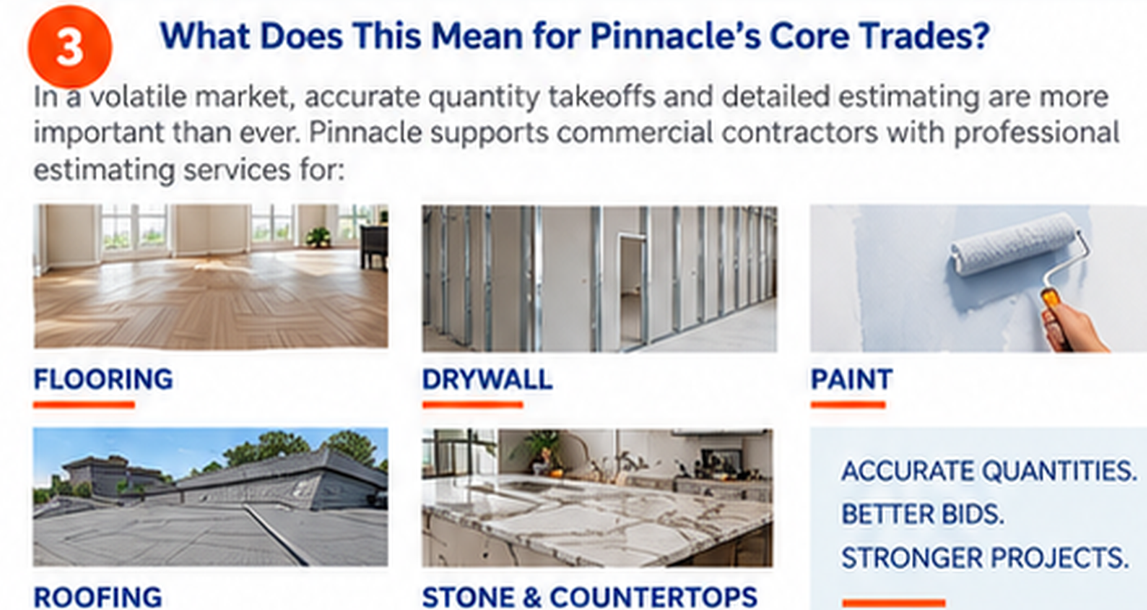
Pinnacle supports commercial estimating across flooring, drywall, paint, roofing, stone and countertop scopes.
- Flooring: Accurate quantities for flooring systems, base, transitions, adhesives and specified accessories become even more valuable when transportation and material costs are moving quickly.
- Drywall: Gypsum board, metal framing, ceilings, insulation and related assemblies can involve very large quantities. Small takeoff errors multiplied across a major project can become significant financial exposure.
- Paint: Reliable measurements across walls, ceilings, doors and specialty coatings help ensure that the bid reflects the complete scope rather than only the obvious square footage.
- Roofing: Petroleum-linked membranes, insulation, fasteners, metals and freight can be particularly sensitive to energy and supply-chain volatility.
- Stone & Countertops: High-value materials make precise quantities, waste assumptions and scope clarity especially important because even modest errors can quickly affect margin.
The Other 2026 Constraint: People and Capacity
Price volatility is only part of the challenge. Construction is also competing for people. The supplied mid-year report estimates that the industry needed to attract approximately 349,000 new workers in 2026 just to keep pace with demand, followed by another 457,000 in 2027. It also cites research projecting that more than 2 million trade positions could go unfilled by 2030.
Those figures describe the broader construction workforce, but the same capacity problem is familiar in preconstruction. Experienced estimators are difficult to recruit, train and retain, and bid volume rarely stays perfectly level throughout the year.
That is why estimating capacity should be viewed differently in 2026. A contractor does not necessarily need to add permanent payroll every time its bid pipeline expands. A professional estimating partner can provide additional office-based capacity when needed and allow the contractor to scale back when demand normalizes.
Pinnacle Is an Office-Based Estimating Partner – Not a Field Estimating Service
Pinnacle’s estimators perform their work in dedicated office environments using digital drawings, specifications, quantity takeoff platforms and client-preferred software. They are not field estimators and are not presented as jobsite personnel.
That office-based model is an advantage. Estimators can focus on plan review, scope interpretation, measurement, revision control and quality review without the competing demands of field supervision. It also supports standardized processes across multiple projects and trades.
For clients, the result is a scalable extension of the preconstruction function: the contractor continues to own its customer relationships, pricing strategy and final bid decisions, while Pinnacle provides the detailed quantity-estimating support behind those decisions.
From Fixed Overhead to Flexible Estimating Capacity
In a stable market, adding permanent estimating staff can make sense. In a volatile market, however, contractors also need the ability to respond quickly to peaks and valleys in bid volume.
Traditional Capacity Model
- Hire, recruit and train additional full-time estimators; carry salary, benefits, software and supervision through changing workloads.
- Capacity may be constrained during peaks and underutilized during slower periods.
Flexible Capacity with Pinnacle
- Maintain the contractor’s core team and add professional estimating capacity as bid volume requires.
- Scale estimating support up or down while preserving internal focus on pricing, customer relationships and project execution.
This model does not replace the contractor’s estimating knowledge. It extends it. The goal is to increase bid capacity without forcing fixed overhead to rise at the same pace.
Technology Changes the Equation – but Human Judgment Still Matters
AI and digital construction tools are moving rapidly into estimating. They can accelerate specification review, organize documents, assist with repetitive tasks and help teams collaborate more efficiently.
But commercial estimating is not simply a pattern-recognition exercise. Drawings may be incomplete. Specifications can conflict. Addenda can change scope late. Trade boundaries can be unclear. The estimator still has to understand the construction logic behind the quantity.
Pinnacle’s approach is therefore technology-enabled rather than technology-dependent. Digital tools improve speed and consistency, while trained estimators remain responsible for interpreting scope and producing the deliverable.
Quality Control Becomes More Valuable as Margins Tighten
Pinnacle’s current public company materials emphasize its Quality-Driven Estimation process and a three-layer Primary – Secondary – Tertiary verification structure. The purpose is straightforward: reduce avoidable quantity errors before the estimate reaches the client.
That matters more in the present market because external forces are already compressing margins. A contractor cannot control an oil shock, a tariff change or a supplier price increase. It can, however, control the rigor of its estimating process.
The strongest estimating partner is therefore not the one that simply produces a takeoff quickly. It is the one that can combine speed with repeatable process, trade knowledge, communication and review.
Why a U.S.-Headquartered Partner Matters More in an Uncertain World
Pinnacle Estimating Services is headquartered in Sterling, Virginia and serves commercial and residential subcontractors across North America. Its current public company materials describe a large office-based estimating organization supported by U.S.-based account management.
For American contractors, that structure creates an important combination: a U.S.-based business relationship and point of accountability, paired with scalable estimating resources and dedicated trade expertise.
When the market is predictable, efficiency matters. When the market is volatile, communication, continuity and accountability matter just as much. Contractors need to be able to discuss an estimate, challenge a quantity, explain their preferred methodology and have their estimating partner adapt to the way they bid work.
That is the difference between treating estimating as a commodity and treating it as part of the contractor’s preconstruction strategy.
The Best Response to Uncertainty Is Not to Stop Bidding. It Is to Bid Smarter.
The contractor cannot control geopolitics. It cannot control oil markets, tariffs, interest rates or labor shortages. And it cannot know exactly what material prices will be six months from now.
But it can control how thoroughly an opportunity is evaluated before the bid is submitted. It can control the quality of its takeoff process. It can control how much fixed estimating overhead it carries. It can choose where technology adds value. And it can choose partners capable of scaling with its business.
The companies that emerge strongest from 2026 may not simply be the largest. They may be the most adaptable – the contractors that protect margins while remaining aggressive enough to pursue the opportunities that continue to emerge.
Partner With Pinnacle Estimating Services
For flooring, drywall, paint, roofing, stone and countertop contractors, accurate quantity estimating is increasingly becoming a margin-protection tool rather than a back-office administrative task.
Pinnacle Estimating Services combines a U.S.-headquartered client relationship with office-based estimating teams, trade specialization, technology-enabled workflows and structured quality review to help contractors expand bid capacity without expanding fixed overhead at the same rate.
Pinnacle Estimating Services
www.pinnacle-cst.com | info@pinnacle-cst.com
Sources & Editorial Notes
- Commerce Bank, “Weathering Uncertainty: Construction’s Mid-Year Assessment,” 2026. Source document supplied for this article.
- Associated General Contractors of America (AGC), 2026 construction input-cost updates, including June and July 2026 releases.
- Pinnacle Estimating Services website and current public company materials, accessed September 2026.
- Company positioning in this article refers to Pinnacle as a U.S.-headquartered estimating company with U.S.-based account management. Estimators are represented as office-based professionals, not field personnel.
- All photography/graphics in this Word document are illustrative and are not represented as photographs of actual Pinnacle employees or client projects.